ICB mergers come into effect under phase 1 of new health footprints, in an attempt to reduce care board running costs and align health boundaries with strategic authorities.
In September 2025, the Minister of State for Health announced a structural overhaul of ICB boundaries through a series of strategic mergers. These changes are now in effect: 12 of the original 42 health boards have been legally dissolved to make way for six new “super-sized” boards. Following these consolidations, the total number of ICBs in England has been reduced from 42 to 36.
These reforms are a cornerstone of the government’s 10-Year Health Plan, which aims to modernise healthcare delivery across England. Alongside these mergers, the plan introduces “cluster arrangements” to streamline leadership and ensure the NHS meets its performance targets.
ICB Mergers: Structural dissolution
With the goal of improving efficiency and maximising resources, ICB mergers were designed to align with one or more strategic authorities wherever feasible. Consolidating these boundaries facilitates seamless service integration and reinforces a government commitment to enhancing the NHS.
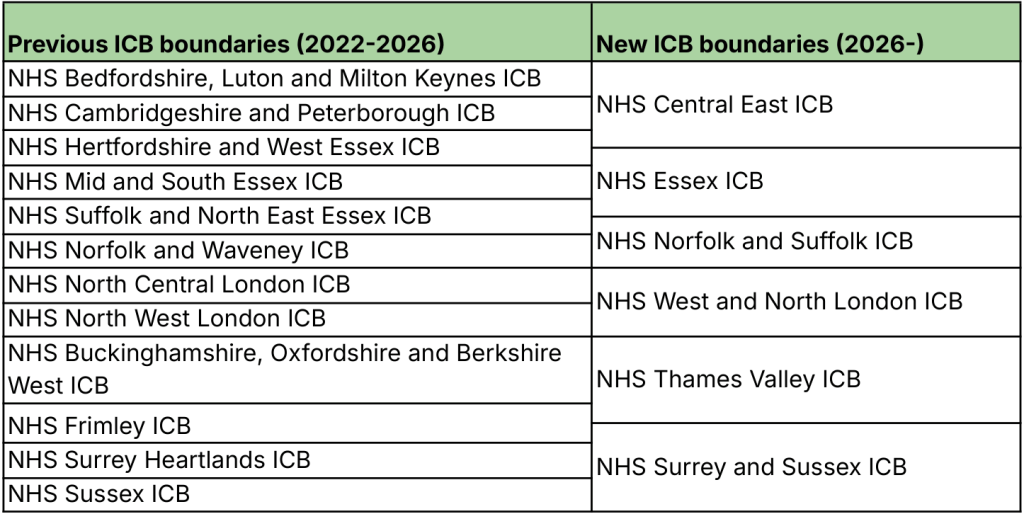
As of April, the following 12 ICB footprints have been legally closed:
- NHS Bedfordshire, Luton and Milton Keynes ICB (QHG)
- NHS Cambridgeshire and Peterborough ICB (QUE)
- NHS Hertfordshire and West Essex ICB (QM7)
- NHS Mid and South Essex ICB (QH8)
- NHS Suffolk and North East Essex ICB (QJG)
- NHS Norfolk and Waveney ICB (QMM)
- NHS North Central London ICB (QMJ)
- NHS North West London ICB (QRV)
- NHS Buckinghamshire, Oxfordshire and Berkshire West ICB (QU9)
- NHS Frimley ICB (QNQ)
- NHS Surrey Heartlands ICB (QXU)
- NHS Sussex ICB (QNX)
The 12 health boards were restructured by merging existing sub-ICB locations or integrating specific Lower Super Output Areas (LSOAs) to form six consolidated “super-sized” boards:
- NHS Central East Integrated Care Board (S1Y5D)
- NHS Essex Integrated Care Board (D7T5G)
- NHS Norfolk and Suffolk Integrated Care Board (T6Y0W)
- NHS West and North London Integrated Care Board (Z9B2Z)
- NHS Thames Valley Integrated Care Board (S0E4D)
- NHS Surrey and Sussex Integrated Care Board (S9B9J)
Additionally, the NHS Hampshire and Isle of Wight ICB (QRL) remains a legal entity but has undergone boundary changes. This redrawing was completed by incorporating LSOAs from the former Frimley boundary into the existing ICB.
For all affected boards, the original Organisation Data Service (ODS) codes – the three-character ICB identifiers – will remain operationally active for approximately six months to assist the transition.
ICB Clusters: Shared leadership
Unlike the mergers, which saw 12 boards scrapped entirely, the clustering initiative saves costs by retaining the legal independence of the remaining ICBs while consolidating their management.
The goal is to eliminate administrative duplication. Under a cluster arrangement, multiple ICBs share a single Chief Executive and executive board. This allows for a unified strategy and reduced running costs while ensuring that each individual ICB maintains its own legal status and specific geographical accountability.
The current clusters include:
- South East London ICB and South West London ICB cluster
- Birmingham and Solihull ICB and Black Country ICB cluster
- Coventry and Warwickshire ICB and Herefordshire and Worcestershire ICB cluster
- Derby and Derbyshire ICB, Lincolnshire ICB and Nottingham and Nottinghamshire ICB cluster
- Leicester, Leicestershire and Rutland ICB and Northamptonshire ICB cluster
- Shropshire, Telford and Wrekin ICB and Staffordshire and Stoke-on-Trent ICB cluster
- Bath and North East Somerset, Swindon and Wiltshire ICB, Dorset ICB and Somerset ICB cluster
- Bristol, North Somerset and South Gloucestershire ICB and Gloucestershire ICB cluster
- Cornwall and Isles of Scilly ICB and Devon ICB cluster
What this means for health data
For the boards affected by these mergers, the transition will require a swift update to underlying reporting systems. Although the super-boards face the logistical challenge of consolidating disparate IT infrastructure and patient records, the original three-character Organisation Data Service (ODS) codes will remain operationally active for approximately six months to minimise disruption.
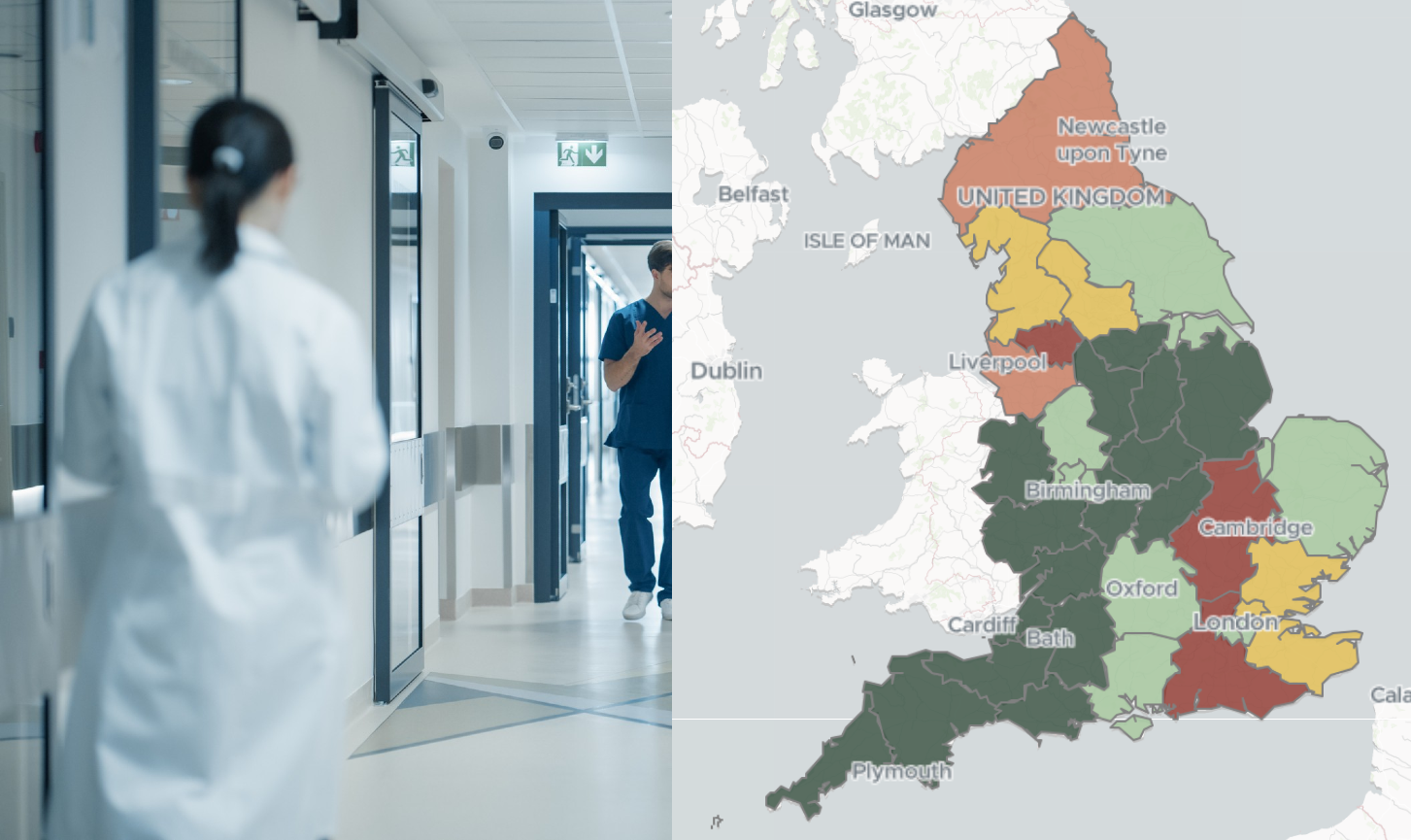
As of June 2026, several public health datasets, including community health services and NHS Referral-to-Treatment (RTT) waiting times, have already adopted the new boundaries, signaling a fast-paced implementation across England’s health services. The map below shows how the new boundaries look using the June dataset for waiting times in England. Double click on the map or use the search bar to learn more about the picture in your area.
In this transition period, where both old boundaries and new are being used in data publication, this raises challenges for those looking to use health datasets. To help navigate this shifting landscape, we have also created a dedicated visualisation of the legacy boundaries, showing how the old boards are transforming. Click here to launch the interactive map.
Health boundaries and devolution
To better align public service boundaries and harness the benefits of joint strategic planning, these mergers and clusters have been designed to work in tandem with local government reorganisation and the broader devolution process. This structural alignment supports a “health in all policies” approach.
A landmark shift toward local healthcare decision-making has already introduced health devolution in Greater Manchester and South Yorkshire. Under these plans, NHS England will appoint a new ICB Chair in each region who also serves as the Mayor’s Health Commissioner. These leaders hold a dual mandate, reporting jointly to the national health service and to democratically elected local mayors.
As Local Government Reorganisation progresses, the evolution of the health landscape will continue. Next summer, further ICB mergers and boundary changes will be determined, with a scheduled implementation date of 1 April 2027.
Katherine Merrifield, assistant director at The Health Foundation, notes: “The creation of mayoral health commissioners is a significant step. It has the potential to bring the NHS closer to communities and to support a more preventative, locally led approach. The challenge now is to ensure this reform delivers on its promise: not just changing who sits around the table, but enabling a genuinely joined-up approach, where healthcare is aligned with sustained action on the building blocks of health.”