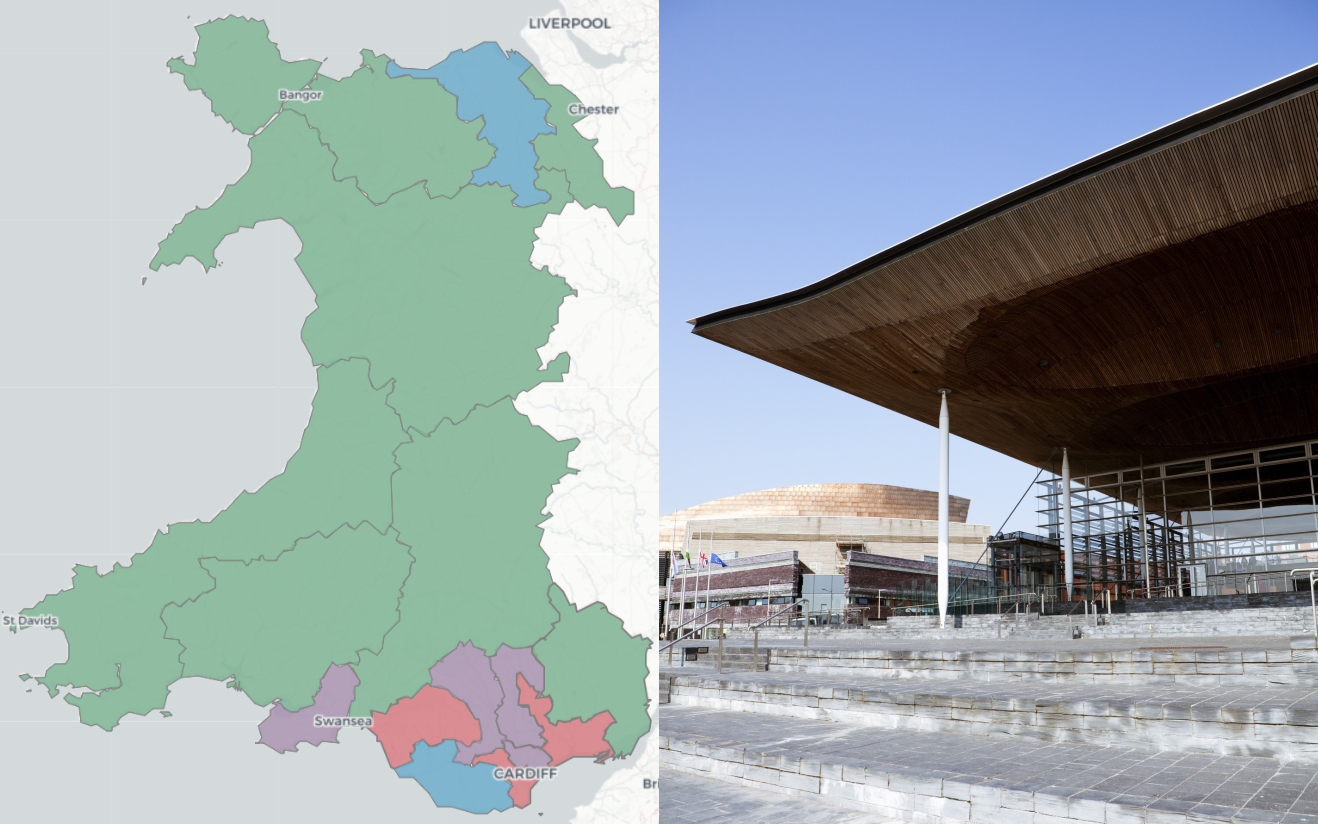
In this visualisation, we have mapped an average of the Index of Multiple Deprivation measure by the new 2026 Senedd Constituency boundaries, as well as counts of least and most deprived LSOAs for each area.
LSOA areas were provided an Index of Multiple Deprivations decile score based on IMD ranking. This score was averaged across each constituency to produce a constituency level measure.
Source: Welsh Government
Following the release of the Welsh Index of Multiple Deprivation (WIMD) 2025, Polimapper has exclusively mapped these insights against the new 2026 Senedd Constituency boundaries.
Developed by the Welsh Government, the WIMD 2025 serves as the definitive measure of relative deprivation for small areas across Wales. The index ranks every Lower Layer Super Output Area (LSOA) – a standard ONS statistical geography – to identify pockets of deprivation.
The new iteration of the WIMD was calculated across eight domains to provide a comprehensive snapshot of local deprivation. The domains and their weightings are:
- Income, 22%.
- Employment, 20%.
- Health, 15%.
- Education, 14%.
- Access to services, 10%.
- Housing, 9%.
- Community safety, 5%.
- Physical environment, 5%.
Key WIMD25 insights at the Senedd Constituency level
The new indices reveal that the most deprived small area in Wales is in Rhyl West, Denbighshire; a neighbourhood that also topped the deprivation rankings in 2019. Conversely, the least deprived LSOA is located in St Kingsmark, Monmouthshire.
The data team at Polimapper has plotted the Welsh IMD data to the 2026 Senedd Constituency level, allowing for a granular view of the indices within each of the new Senedd boundaries.
According to the visualisation, all constituencies now contain at least two of the most deprived 10% of neighbourhoods in the country. Afan Ogwr Rhondda recorded the highest concentration of these areas, containing 25 of the most deprived LSOAs.
Furthermore, by averaging the decile values for each constituency, Afan Ogwr Rhondda emerges with the lowest overall ranking across all Senedd areas, and is therefore the most deprived constituency in Wales.
Conversely, all constituencies also contain at least one of the least deprived 10% of neighbourhoods. Caerdydd Ffynnon Taf recorded the highest number of affluent LSOAs with 30. Nonetheless, Pen-y-bont Bro Morgannwg and Fflint Wrecsam saw the highest average across the IMD deciles, indicating that they are the least deprived constituencies overall.
What does the WIMD mean for the 2026 Senedd Elections?
The release of a new Index of Multiple Deprivation for Wales creates significant opportunities for advocacy and political influencing ahead of the 2026 Senedd elections. The recent insights offer up-to-date deprivation measures that can underpin and strengthen campaigns focused on health, education, labour, and housing.
The 2025 indices, derived from 54 indicator datasets, are not only a technical improvement but also carry a higher potential for engagement due to the structural changes occurring in the Senedd this year.
With the number of Senedd constituencies decreasing from 40 to 16 in 2026, Members of the Senedd (MSs) who previously may not have represented deprived neighbourhoods are now likely to represent at least two of the most deprived LSOAs in the country. This means that, due to the expanded geographical coverage of each constituency, these indices are now relevant to every incoming MS in the next government, regardless of the specific seat they win.
As the 2026 campaign gains momentum, the WIMD 2025 will serve as the primary benchmark for measuring socio-economic progress in Wales. For candidates and advocates alike, these insights are no longer just statistics – they are a roadmap for targeted policy intervention.