NHS waiting lists in Wales have risen for a second consecutive month, interrupting nearly a year of progress.
New data from StatsWales reveals that the number of open patient pathways awaiting treatment in Wales increased to 689,721 in May 2026, following almost a year of steady reductions. The Betsi Cadwaladr University Health Board in North Wales accounts for the largest share of the backlog, with 178,606 people currently waiting for treatment.
NHS Wales has set a target for 95% of patient pathways to be seen within 26 weeks of referral. However, as of May 2026, only 65% of pathways met this target, while another 10% waited between 26 and 36 weeks, and a further 25% waited over 36 weeks for treatment.
Additionally, the median waiting time across Wales stands at 15.7 weeks. While Cardiothoracic Surgery faces the longest median wait at 14.5 weeks, Diagnostic Services recorded the shortest at 2.8 weeks.
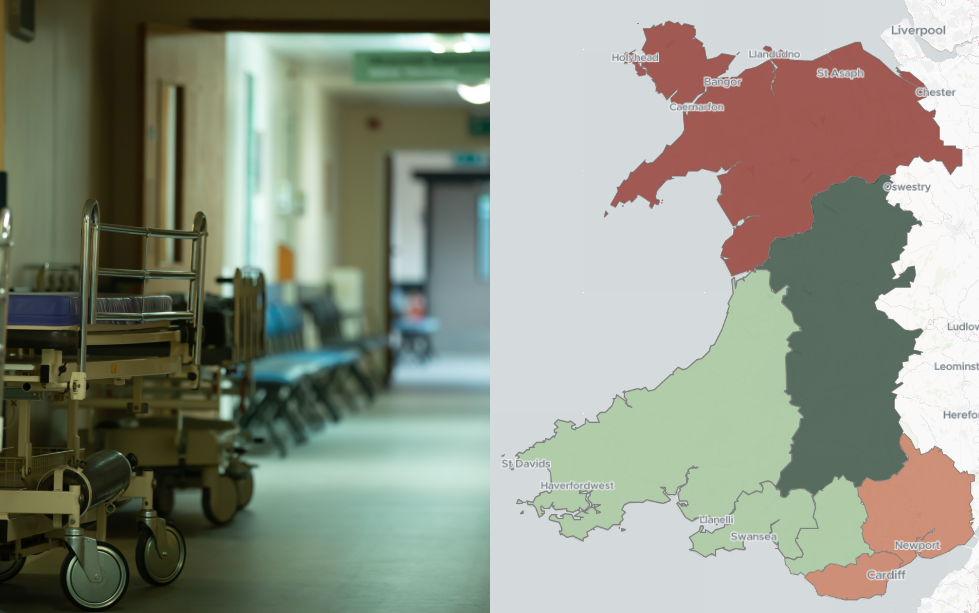
The data team at Polimapper has visualised the Wales waiting time data for May 2026 by health board. The top-performing health board was Powys Teaching, closing 90.2% of pathways within 26 weeks. Conversely, Cardiff and Vale University Health Board saw only 60.5% of pathways closed within target.
Geodata context
Government officials and stakeholders across the healthcare sector have reacted to the figures.
Wales Health and Care Minister Mabon ap Gwynfor: “Too many people are waiting for treatment, and they are waiting too long. We have a plan to tackle this which will deliver the real change the people of Wales need to see and that they rightly deserve,”
“We’re doing things differently to previous approaches. Through our clinically-led surgical hub programme we will strengthen local capacity, get patients treated quicker and ensure that elective care demand is managed more sustainably within day-to-day NHS activity. We are committed to delivering our investment to support waiting list reductions this year.”
Dr. Rob Perry from the Royal College of Emergency Medicine (RCEM): “The new Welsh Government has signalled that it understands the need to reduce long waits and overcrowding, and we are pleased that it is engaging with RCEM on this issue.”
“I hope, for our patients’ sake, that these words become action soon. As today’s figures show, the problem is only going to get worse without the proper interventions.”